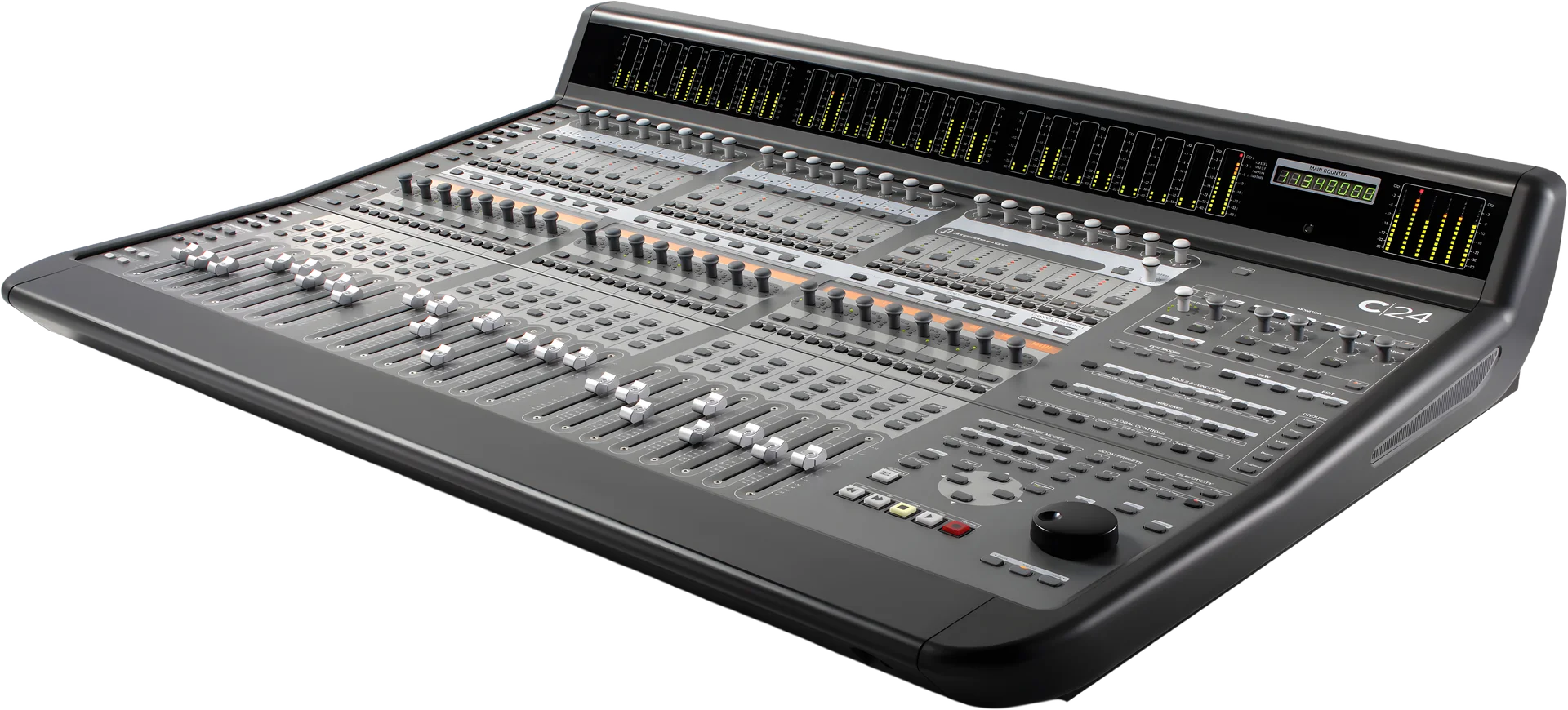
C|24
Digidesign · 2005–2007 · Pro Audio · 58 stakeholders
Mechanical engineering lead for Digidesign's C|24 control surface: a ground-up RoHS re-architecture that killed a ~$200/unit royalty, held a 51.8% gross margin through a supply-chain collapse, and shipped 500 units for Q4 2007 revenue.
Pilot-build collapse on multiple fronts: ABS side caps warped up to 2.50 mm in the paint-cure cycle, the primary vendor no-bid the most complex panel, and the PSU failed certification — all against a hard Q4 2007 revenue date.
Engineered a vertical-hang cure fixture (ECO 12740), ran a dual-source manual-welding bridge, enforced a 50+ DCD geometric firewall across 19 PCBs, and hand-packed 100 units to bypass the certification block.
100% Pilot cosmetic yield recovered, 100% first-build mechanical fit, 500 units shipped for Q4 2007 at a 51.80% gross margin.
C|24 (Curtis) Forensic Report
I. Project Summary
- Role: Mechanical Engineering Lead / Industrial Design Lead.
- Mandate: Execute a total platform modernization (“RoHS/Refresh”) of the legacy Control|24 console: eliminate a ~$200/unit licensing royalty by moving to 16 in-house pre-amps, integrate 5.1 surround monitoring, cut the form factor to 43 inches, and hold the $9,995 MSRP under the new EU compliance regime.
- Core Achievement: Delivered 500 units for Q4 2007 FQA/revenue recognition despite a dual-front supply chain collapse, a thermal yield crisis during Pilot, and regulatory certification bottlenecks.
II. The Product That Shipped
The refresh wasn’t only crisis triage — it reshaped the product. Against the 43-inch width target I stripped the console down: out went the numeric keypad, the F6–F10 function keys, the eight-button edit section, and four display buttons, on a bet that soft keys and screen-based entry could carry the load. The single-row, four-character readouts became three large 55×2-character Varitronix LCD scribble strips, specified with the ID team (Sheldon Radford) — down to a custom character-ROM set, worked out with Stan Cotey and David Anthony, to carry Japanese katakana. That last requirement nearly broke us: the katakana ROM ran the 2407 DSPs out of flash memory, a firmware crisis hiding behind a cosmetic upgrade. The meter bridge carried 24 Pro Tools track meters on 14-segment LED ladders (nine green, four amber, one red clip), and the workflow reached for ICON-class features: plug-in flip mode on the touch-sensitive faders, the full automation suite (write/touch/latch/read/trim), and a deep diagnostics layer — Vegas mode, the fader step/cycle/group/touch/recalibrate battery, ethernet loopback, and transport-aware auto-talkback.
III. The Anatomy of Failure
1. Thermal Crisis: The “Banana” Defect
- Trigger: During Pilot, the primary ABS Side Caps (P/N 9440-55165/166) arrived with catastrophic geometric distortion: up to 2.50 mm of “banana” warping and 2.27 mm of linear shrinkage. The defect traced to the high-temperature “Rubberized Soft Paint” cure cycle — the vendor baked the long, heavy parts flat on wire racks (“Method C”), letting gravity sag the plastic through its glass-transition phase.
- Intervention: Rejected the vendor’s support-block proposal (“Method B”) and ran a comparative study instead. Engineered “Method A” — a Vertical Hanging Fixture that suspends parts during cure so gravity straightens them during cool-down. Codified the process via ECO 12740 as a permanent manufacturing specification for large ABS parts.
- Result: Reduced flatness deviation from 2.50 mm to below 0.50 mm, salvaging 100% of Pilot cosmetic yield with no new tooling spend.
2. Supply Chain Crisis: The Top Panel “No-Bid” Shock
- Trigger: Mid-schedule, the primary overseas CM (Kwanta) formally no-bid the console’s most complex part — the Top Panel (P/N 9420-55105). Its extreme density of welded standoffs physically blocked the vendor’s automated CNC welding heads, threatening a line-down scenario. (Vendor roles, per operator 2026-07-02: Kwanta = the CM that no-bid; Quanta = a vendor that bid the CM project; VTech = a CM.)
- Intervention: Executed a dual-source bridge strategy: engaged domestic vendor Mass Precision for rapid-turn manual offset-welded prototypes (reworking missing countersinks by hand to keep the line moving) while qualifying a manual offset-welding process at the overseas secondary vendor to bridge the schedule until automation retooled.
- Result: Unblocked the Pilot build and transitioned cleanly from domestic manual parts to overseas automated lines, protecting the November 20, 2007 First Customer Ship date.
- The human cost: Mid-fabrication I fully ruptured my Achilles tendon — a complete break. The night I got back from the hospital I sent the top-panel weld-stud files over hotel wifi, so the fabrication didn’t stall while I was off my feet.
3. Architecture Crisis: The EMI/Thermal “Rake”
- Trigger: The initial 4U chassis stacked the internal power supply directly under the A/D converters, producing catastrophic EMI noise — and the console carried a non-negotiable acoustic constraint. It sits at the engineer’s listening position, so the Product Design Document mandated a fanless shipping product. The easy thermal answer was off the table.
- Intervention: I validated active-cooling fallbacks against the rake layouts before committing to silence. A four-fan crossflow array (4× 80 mm, 12 V) passed on an open bench but failed thermal qualification once the dust filter and plastic side caps were installed — the sealed enclosure trapped its own heat. A three-fan front-to-back arrangement (3× 80 mm at 12 V, or 8.5 V for quieter running, reusing the legacy 4U mounting footprint) met spec as a fallback, pending acoustic sign-off with Sheldon Radford — fan noise at the listening position was a call for the team’s tuned ears (David Gibbons among them, reportedly a perfect-pitch singer). The shipping answer was to remove the heat source instead: re-architect to the revised 3U alignment and move the power supply out of the chassis into the external Skynet brick, with modified PSUs, metal connectors, and shielded cables to break the EMI path.
- Result: A silent, fanless console that holds its 10–35 °C internal window and passes thermal qualification — the architecture that shipped, with the validated fan configurations left on the bench as insurance.
4. Serviceability Crisis: The Headphone Jack Fire Drill
- Trigger: Just before final release, service data showed the legacy headphone jack carried a 4.8% field failure rate — and the flush-mount design buried it behind the front bolster, making a simple repair a 2-hour chassis teardown.
- Intervention: Executed an emergency redesign past the “Tooling Control Off” milestone: modified the Headphone Bracket (9420-55126-00) and Front Bolster (9440-55167-00) to create a recessed “trap door” clearance geometry (ECO 12993).
- Result: Converted a return-to-factory liability into a Field Replaceable Unit — Mean Time To Repair cut from over 2 hours to under 10 minutes via a single nut accessible from the bottom pan.
- The fight: Marketing (Matt Cho, David Gibbons) pushed back — the foam mock-up of the recess broke the console’s clean line. I argued it on the 4.8% number: at that failure rate the jack was not a cosmetic decision, it was a warranty liability. The data won.
5. Integration Crisis: The Geometric Firewall
- Trigger: Integrating 19 distinct PCB assemblies into a low-profile chassis was being undermined by “wild west” file swapping — layout designers independently moving mounting holes and vertical components, guaranteeing downstream collisions. The MicPre 8 I/O vertical power connectors crashed into the bottom pan; SubMix headers landed in zones factory workers could not reach.
- Intervention: Authored and enforced the Data Control Drawing (DCD) Protocol: 50+ binding geometric contracts defining PCB outlines, 0.130” mounting holes, and Z-height keep-out zones. Submitted layouts were overlaid against the 3D master assembly and rejected on a 0.5 mm variance. The MicPre 8 DCD alone ran to Rev 12.
- Result: 100% mechanical fit on the first physical build, decoupling the mechanical tooling schedule from electrical layout iteration.
6. Regulatory Crisis: The Stranded PSU
- Trigger: The external Skynet power supply failed EMC prescans and suffered three catastrophic load failures at 230V/50Hz; tooling delays then stranded finished consoles waiting on UL certification.
- Intervention: Negotiated a simultaneous-certification protocol with UL to test the console surface without the finalized PSU, and orchestrated a hand-pack operation at the Menlo Park facility to manually apply UL labels to the first 100 units.
- Result: Protected the First Customer Ship date and Q4 revenue without regulatory exposure.
7. Component & Geometry Battles
- Bourns EM14 jog wheel: The cost-down 14 mm encoder arrived as raw samples with six exposed 0.42 mm wire leads — a soldering-defect factory. Enforced a pre-terminated harness specification (plug-and-play assembly) and engineered a custom surround with tolerance analysis that preserved the premium “scrub” feel of a $10k console on commodity parts (integration bracket via ECO 13082).
- The “Gill” surfaces: The signature side gills’ complex curves broke vendor CAD imports. Rebuilt the Class-A transitions manually in Pro/Engineer (16.5 hours) and exported geometry in bite-sized STEP chunks the toolmaker could digest — a modeling failure turned seamless assembly.
- The “Kenny” cosmetics war: The secondary metal vendor shipped panels with ripples, dents, and “dental white” silkscreen that washed out against the grey chassis. Enforced a First Article Inspection regimen, forced ink recalibration to true Bright White, and documented bend-line defects photo-by-photo until the vendor upgraded its tooling.
- Dust behind the meter lens: The vendor proposed a multi-week mold retool to chase contamination trapped behind the meter window. I specified an adhesive-backed foam seal instead — killed the defect without touching the schedule.
- Tolerance & routing fixes: Set the Bourns jog-wheel bracket mounting-hole tolerance to ±0.05 mm to settle a table wobble (ECO 13526), and pulled mounting hole MH5 off the SubMix board where it was fouling a critical trace route.
IV. Governance & Rhythm
- The Pulse: Managed under a constant “At Risk/Replan” status from an initial Q1 2007 target to the November 2007 ship, with weekly War Room coordination across Silicon Valley and Guangdong. The mechanical architecture was a solo mandate: one engineer integrating 100+ unique components — 19 PCB assemblies, 15 sheet-metal parts, 25+ molded parts, plus cables and hardware — inside extreme geometric constraints.
- The Method: I don’t redesign what isn’t failing. On the meter assembly I traced the field history through the repair bench (via Ed Bangert) and found the LED spacers had a zero replacement record — so I kept the legacy design and spent the tooling budget where parts were actually breaking. Same instinct at kickoff: I asked for a nonfunctional “dog unit” — a dead sample — to tear down before I drew a line.
- The Artifacts:
- DCD Protocol — the geometric firewall; 50+ binding drawings, MicPre 8 at Rev 12.
- General Modeling Guide — authored to hold data integrity through the Pro/Intralink 8.0 server migration.
- ECO 12740 — vertical-hang cure fixture, released as a permanent process specification.
- ECO 12263 — urgent “release all” of sheet metal and artwork to salvage the schedule.
- ECO 12993 — headphone-jack trap-door serviceability redesign.
- ECO 13082 — Bourns jog wheel integration bracket (P/N 9420-56156-00).
- ECO 13707 — re-dimensioned drawings with hardened tolerances to lock inspection criteria.
V. Quantified Impact
- Delivered 500 units for Q4 2007 FQA and revenue recognition through a binary line-down supply crisis.
- Eliminated the ~$200/unit licensing royalty by re-architecting the chassis around 16 in-house pre-amps.
- Secured a 51.80% gross margin on a $9,995 MSRP despite a 20% annual rise in raw steel costs.
- Held the $9,995 MSRP globally by absorbing bridge tooling as a project expense rather than permanent COGS.
- Salvaged 100% of Pilot cosmetic yield by correcting 2.50 mm thermal warp to below 0.50 mm.
- Cut headphone-jack MTTR from over 2 hours to under 10 minutes with the trap-door FRU redesign.
- Achieved 100% mechanical fit on the first physical build of all 19 PCB assemblies.
- Enforced the geometric firewall with 50+ Data Control Drawings.
- Managed 13 major ECOs inside a compressed 6-month window to realign production tooling with design reality.
- Processed 100 units through the Menlo Park hand-pack to bypass the stranded-PSU certification block.
VI. Market Context & Legacy
Everything above this line I can pin to an artifact — an ECO number, a DCD revision, an inspection report with a measurement on it. This section is the exception, and I flag that up front. It is the view from outside the bench: where the C|24 was positioned, the platform I inherited, what the market came to value, and how it aged after I had moved on. The external material here — competitive framing, resale values, awards, end-of-support dates — comes from a secondary deep-research pass (NotebookLM, confidence: low), not from my own records, and the reports do not always agree with one another. I have marked every claim I cannot personally vouch for as ⚠ needs Erik’s sign-off; each one I will either stand behind from memory or cut. None of it is load-bearing the way the engineering record is.
1. The Position: An All-in-One Bet at $9,995
The C|24 was never meant to be the cheapest control surface — it was meant to be the one that did everything in a single box. The $9,995 was the PRD target: the MSRP the cost structure was designed to hold, and the number I owned through the build. (Street, dealer, and configured-system pricing sat around and above it, so retrospective price figures vary — the MSRP target is the one to anchor on.) One chassis fused a 24-fader control surface, 16 mic pres, and a 5.1 monitor section, so a project or commercial studio could buy one unit instead of three. That integration was the product thesis, and it is the lens every market comparison runs through.
Against the field, the C|24 sat in a deliberate slot: well below Digidesign’s flagship ICON desks (the D-Control and D-Command ran into the tens of thousands) ⚠ needs Erik’s sign-off, and above the entry-level tactile controllers. The retrospective research frames its launch reception as the de-facto all-in-one standard for the mid-tier Pro Tools room ⚠ needs Erik’s sign-off, with its nearest later reference points being the Avid S3 (which moved to the higher-resolution Eucon protocol) ⚠ needs Erik’s sign-off, the SSL UC8 (tied to the older HUI protocol) ⚠ needs Erik’s sign-off, and the Euphonix-derived Avid Artist Series at the low end ⚠ needs Erik’s sign-off. The protocol point matters for the legacy, and I return to it below.
2. The Platform I Inherited
I was not designing in a vacuum — I was re-architecting a platform with a specific inheritance. The original Control|24 (2001) was a Digidesign–Focusrite joint venture: Focusrite built the hardware and supplied 16 Class-A preamps, while Digidesign owned the Pro Tools integration ⚠ needs Erik’s sign-off. Its dual-tier “stadium” chassis carried an internal switch-mode supply that ran hot in always-on studios — a known reliability liability ⚠ needs Erik’s sign-off.
That inheritance is my mandate, restated from the outside. The moves the page documents — killing the licensed-preamp royalty by going to 16 in-house pre-amps, pulling the supply out to an external brick, and dropping to a low-profile single-tier chassis — line up exactly with what the retrospective reads as the C|24’s defining improvements over its predecessor ⚠ needs Erik’s sign-off. That is the useful part of an outside check: the secondary research independently traces the same Focusrite-royalty exit and the same thermal-driven PSU relocation I executed on the bench.
3. What the Market Valued — and What It Did Not
Strip away the spec sheet and the thing buyers kept returning to was the tactile real estate: 24 touch-sensitive motorized faders in front of you, not 8 banked and paged. For a dense session that physical channel count is the entire argument, and the secondary research reads it as the C|24’s most durable value driver ⚠ needs Erik’s sign-off. That tracks with why I fought the fader-panel tolerances so hard through Pilot — the faders were the product.
One feature in particular punched above its price and kept showing up in the affection: the “Etch-a-Sketch” surround pan — two rotary encoders driving X/Y placement across a 5.1 field, so an engineer could spot a sound by feel instead of buying a separate joystick module. I built that one, so I’ll vouch for it directly; that it aged into part of the unit’s folklore is the market telling me which details landed.
I will record the honest knocks too, because a portfolio that lists only wins is not forensic. The external analysis surfaces three recurring criticisms: the 16 onboard preamps were heard as clean but neutral, short of the harmonic character of high-end outboard ⚠ needs Erik’s sign-off; the DB25 analog I/O loom was a real and often-unbudgeted add-on cost ⚠ needs Erik’s sign-off; and the all-metal chassis that gave the unit its pro feel also made it heavy to move ⚠ needs Erik’s sign-off. The weight I will own outright — that mass was a deliberate choice, the same powder-coated steel I spent the project defending against ripple and warp. The preamp and cabling critiques are market perception I would want to confirm before publishing.
4. The Long Tail: How It Aged
The decisions I locked in 2007 set the unit’s shelf life, and two of them defined the legacy:
- Protocol, not metal, was the expiration date. The C|24 spoke a proprietary Ethernet-based Pro Tools control layer, and when Pro Tools went 64-bit (v11) and Avid steered the ecosystem toward the Eucon-based S-series, the hardware was displaced rather than worn out ⚠ needs Erik’s sign-off. The chassis I built to survive a manufacturing death-march outlived the protocol it was built to carry — on integrated hardware, the software contract ages faster than the steel.
- It refused to die on the used market. The research traces a long depreciation curve and an eventual end-of-support milestone around 2022 ⚠ needs Erik’s sign-off, alongside resale tiers the reports themselves disagree on — I am deliberately not restating any of them as fact ⚠ secondary estimates, mutually inconsistent — do not cite as a number. The durable signal is qualitative: third-party software (Neyrinck’s V-Control Pro) emerged to bridge the legacy surface onto current Pro Tools and even other DAWs — Logic, Cubase, Studio One — on modern operating systems ⚠ needs Erik’s sign-off. Owners keep them in service through custom-desk conversions, and used-gear buyers still lean on the board’s built-in “Vegas Mode” lamp-and-fader self-test to vet a unit before purchase ⚠ needs Erik’s sign-off. People do not write drivers, or build furniture, for hardware nobody still runs.
5. The Validation
The strongest evidence that the platform landed is that it shows up in work that mattered. I hold these at arm’s length — they are secondary, and the credit belongs to the records and the engineers who made them, not to me — but they are worth recording:
- The lineage was decorated early: the predecessor Control|24 took the 2001 TEC Award for Small-Format Console Technology, validating the hybrid “controller-plus-analog-front-end” concept the C|24 then refined ⚠ needs Erik’s sign-off.
- The C|24 itself became a working tool in high-profile rooms — cited as the primary surface in Taylor Swift’s Speak Now personal-studio setup ⚠ needs Erik’s sign-off, and in the rig of TEC-winning mix engineer Adrian Bushby ⚠ needs Erik’s sign-off. The trade press (Sound on Sound, Mix) reviewed it on release as a mid-studio “surefire winner” ⚠ needs Erik’s sign-off.
The legacy line I would most want to put in my own words, rather than a research summary, is this: the C|24 was built well enough, and integrated tightly enough, that the market kept it working long after Digidesign stopped supporting it. The RoHS re-architecture, the in-house preamps, the low-profile chassis I salvaged through Pilot all shipped 500 units for Q4 2007 — and then kept running, in real studios, for the better part of two decades.
VII. Source Trail
The engineering claims in Sections I–V rest on the project’s primary evidence archive — engineering change orders, data control drawings, vendor inspection reports, and build photography — compiled through the NotebookLM forensic registry (the Market Context & Legacy section above stands on secondary research and carries its own caveat):
944055165-166-00 baking fixture chg.pdf— warped ABS parts on flat racks vs. the vertical hanging fixture.before_and_after_rubber_paint.pdf— inspection logs proving 2.27 mm paint-cure shrinkage.DCD_9150-55200-00_REV_12.pdf— the MicPre 8 geometric contract at its twelfth revision.China Sheet Metal.pdf— photographic record of rejected vendor panels (ripples, dents, washed-out silkscreen).C24_plastic_fit-misc.pdf— fit-check interference and PEM insert pull-out failures.fit-check-01.jpg/C24_first-shot_gap-check.pdf— gap analysis of plastic shrinkage against sheet metal.gill_dim.pdf— finalized dimensions for the rebuilt side-gill surfaces.bourns_em14.pdf— integration specification for the replacement jog wheel encoder.ECO_12263.pdf— the urgent sheet metal release that put production back on schedule.
Visual Evidence
Origin Story· 17


Side Cap Crisis· 11


Manufacturing Wins· 6


Structural Components· 19


Paper Trail· 7


Press Resources· 6


